Three World-Class Gardens, One Postcode
Most places in England are lucky to have one significant botanical garden within easy reach. Kingston has three — and they happen to be among the most important in the world.
To the south, RHS Garden Wisley sprawls across 240 acres of Surrey countryside, the flagship of the Royal Horticultural Society and the engine room of British gardening science. To the north, Royal Botanic Gardens, Kew holds UNESCO World Heritage status, the world’s largest collection of living plants, and Victorian glasshouses that changed architecture forever. And right next door — literally across Kingston Bridge — Hampton Court Palace has 60 acres of royal gardens with over 500 years of history layered into every bed.
What makes this trio remarkable isn’t just proximity. Each garden represents a fundamentally different approach to plants and landscape. Kew is global botanical science. Wisley is practical horticulture. Hampton Court is royal garden history. Together, they cover nearly every dimension of our relationship with the plant world.
This guide goes deeper than the practical “what to visit” — it’s about what makes each of these places significant, who built them, and why they matter.
Royal Botanic Gardens, Kew
UNESCO World Heritage. 300 acres. Founded 1759.
Kew Gardens was inscribed on the UNESCO World Heritage List in July 2003, under three cultural criteria — recognising its contribution to botanical science, its role in advancing ecology, and the significance of its landscape design by Charles Bridgeman, William Kent, and Lancelot “Capability” Brown.
Those aren’t honorary nods. Kew holds approximately 8.5 million preserved plant and fungal specimens in its herbarium — representing around 95% of all vascular plant genera on Earth. The Millennium Seed Bank at Wakehurst stores over 2.5 billion seeds from more than 40,000 species across 190 countries. This is, by any measure, one of the most important scientific institutions in the world.
But you don’t need to know any of that to feel it. Walk into the Palm House on a winter morning and the humidity hits you like a wall — banana plants, cycads, and cocoa trees thriving in conditions that mirror equatorial forest, all enclosed in curving Victorian ironwork that was, in 1848, the first large-scale structural use of wrought iron in architecture. The builders borrowed techniques from shipbuilding, which is why the Palm House looks like the upturned hull of a ship.
The History
The story begins in the 1720s, when George II and Queen Caroline took Richmond Lodge as their summer residence. Their son Frederick, Prince of Wales, developed a passion for botany and began collecting exotic plants. After Frederick’s death in 1751, his widow Princess Augusta of Saxe-Gotha-Altenburg continued the work, and in 1759 she formally founded a nine-acre botanic garden within the pleasure grounds — appointing William Aiton as head gardener. By 1768, the collection had grown to over 2,700 species.
The decisive figure was Sir Joseph Banks, appointed informal director by George III in 1773. Banks dispatched botanists across the globe to gather specimens, served simultaneously as President of the Royal Society for 41 years, and transformed Kew from a royal garden into arguably the pre-eminent botanical institution in the world. As Country Life put it, “no one before or after Banks has had such influence in the sphere of botany.”
What You’re Actually Looking At
The Palm House (1844—1848) — Designed by Decimus Burton and engineered by Richard Turner, this was the first building to use Kennedy & Vernon’s newly patented rolled wrought iron I-beams, originally designed for ship decks. It remains the world’s most important surviving Victorian glass and iron structure. Inside: tropical rainforest plants in carefully controlled humidity.
The Temperate House — Also by Burton. Twice the size of the Palm House, 60 feet high, with underfloor heating and drainpipes concealed inside the pillars. Completed in phases between 1862 and 1899, it’s the largest surviving Victorian glasshouse in the world. Reopened in 2018 after a five-year restoration, housing 10,000 plants from temperate regions — some critically endangered.
The Great Pagoda — Built in 1762 by Sir William Chambers for Princess Augusta. Ten storeys, 163 feet tall, 253 steps, inspired by the Porcelain Pagoda at Nanjing. The original 80 gilded wooden dragons were removed by 1784 — restored and returned in the 2018 reopening.
The Treetop Walkway — Designed by Marks Barfield Architects (the team behind the London Eye). Opened in 2008, 18 metres high, 200 metres long, looping through beech, sweet chestnut, and oak canopy. Below it, the Rhizotron — the UK’s only walk-in viewing area illustrating tree root biology.
The Hive — A 55-foot aluminium structure by Wolfgang Buttress, originally created for the UK Pavilion at the 2015 Milan Expo. 170,000 aluminium parts and 1,000 LED lights that glow in response to real-time vibrations from actual bees in the garden. The soundtrack is composed to a live feed of beehive sounds in the key of C.
2026 at Kew
| Event | Dates |
|---|---|
| Orchids: China (30th anniversary festival) | 7 Feb — 8 Mar |
| Henry Moore: Monumental Nature | From 9 May |
| Christmas at Kew | Nov 2026 — Jan 2027 |
The Henry Moore exhibition places 30 monumental sculptures across the gardens — the most comprehensive Moore show in a generation. Worth timing a visit around.
Getting There from Kingston
| Mode | Route | Time |
|---|---|---|
| Train | Kingston to Richmond (8 min), then District Line one stop to Kew Gardens | ~25 min |
| Bus 65 | Direct from Kingston to Kew Road / Victoria Gate | ~35 min |
| Car | A307 through Richmond | ~20 min |
| Bike/walk | Thames Path — 7 miles of riverside route | ~40 min cycling |
Entry: £20—22 adult (weekday/weekend). Under 4s free. Off-peak (Nov—Jan) from £12.
RHS Garden Wisley
The RHS Flagship. 240 acres. Given to the nation in 1903.
If Kew is about global botanical science, Wisley is about practical gardening — but on a scale and depth that makes it one of the most important horticultural institutions in the world. This is where the Royal Horticultural Society tests which plants actually perform in British gardens, trains the next generation of horticulturists, and — since 2021 — houses the UK’s first dedicated centre of horticultural science.
Wisley was the second most-visited paid-entry garden in the UK in 2025, with over 1.25 million visitors. It has grown from a 60-acre experimental plot into 240 acres of world-class gardens, but the experimental spirit that founded it remains embedded in everything here.
The History
The origins are unexpectedly personal. In 1878, a Victorian businessman named George Ferguson Wilson — treasurer of the RHS and an obsessive orchid grower — bought Glebe Farm, a 60-acre site in the village of Wisley. With help from the legendary garden designer Gertrude Jekyll, Wilson created the “Oakwood Experimental Garden”, where he tried to grow plants that were considered impossible under English conditions: lilies, gentians, Japanese irises, water plants.
Wilson died in 1902. The following year, the garden was purchased by Sir Thomas Hanbury, a philanthropist best known for creating the celebrated La Mortola garden on the Italian Riviera. In 1903, Hanbury gave the entire site in trust to the Royal Horticultural Society. The RHS relocated from Chiswick, and the transformation began.
By 1907, a laboratory and the School of Horticulture had opened. By 1910, the Rock Garden — built in Sussex sandstone — was one of the first areas to be formally landscaped. In 1936, the adjacent Portsmouth Field was purchased and planted as Battleston Hill, now famous for its spring display of rhododendrons, magnolias, and camellias.
The most dramatic chapter is recent. Between 2019 and 2021, the RHS invested over £55 million in the Hilltop development — a new Welcome Building (2019) and RHS Hilltop, The Home of Gardening Science (2021), designed by WilkinsonEyre. It’s the largest single investment in horticultural science ever made, and it houses the RHS Herbarium, scientific laboratories, and a library containing one of the most important horticultural book collections in the world.
What You’re Actually Looking At
The Glasshouse (2007) — Designed by Peter van de Toorn Vrijthoff, opened by Queen Elizabeth II. £7.7 million of curved tempered glass soaring 12 metres high, housing three computer-controlled climate zones: tropical, temperate, and arid desert. The surrounding landscape was designed by Tom Stuart-Smith; in 2024, the borders were redeveloped by Piet Oudolf — one of the world’s most influential planting designers.
The Jellicoe Canal — Designed in 1970 by Sir Geoffrey Jellicoe, one of the 20th century’s most important landscape architects (he founded the Landscape Institute in 1929 and was the founding president of the International Federation of Landscape Architects). A formal east-to-west water channel planted with waterlilies, running alongside the Grade II Listed Old Laboratory — together forming the most photographed view in the garden.
The Old Laboratory (1914—1916) — Don’t be fooled by its Tudor appearance. This Grade II Listed building was purpose-built in the Surrey Vernacular style by Pine-Coffin, Imrie and Angell, designed to blend with the rural surroundings. It housed the School of Horticulture lecture theatre and scientific departments for over a century before those functions moved to Hilltop.
Battleston Hill — Described by the RHS as “Wisley’s jewel box.” Twenty-six acres purchased in 1936, planted with rhododendrons, magnolias, and camellias under a canopy of Scots pines. Spring is extraordinary — waves of colour rolling down north-facing slopes. In autumn, the Chinese cedar turns the hill golden.
The Bowes-Lyon Rose Garden — Named after Sir David Bowes-Lyon, President of the RHS from 1953 to 1961 — and brother of Queen Elizabeth The Queen Mother. The memorial pavilion (1964) sits at the head of formal beds that peak from June through September.
RHS Hilltop (2021) — The £35 million centre designed by WilkinsonEyre, clad in sustainably sourced sweet chestnut timber. Two wings: east for laboratories and herbarium, west for public education. Winner of a 2023 RIBA South East Regional Award. Surrounded by four acres of “living laboratories” — the Wellbeing Garden (Matt Keightley), World Food Garden (Ann-Marie Powell), Wildlife Garden, and Greener Skills Garden.
The Trials Field — Where the Award of Garden Merit system comes to life. Multiple varieties of the same plant grown side-by-side in identical conditions, assessed by expert panels over two to four years. The AGM has been running for over a century — if you’ve ever bought a plant with an RHS “AGM” label, this is where it earned it.
2026 at Wisley
| Event | Dates |
|---|---|
| RHS Orchid Show | 13—15 March |
| RHS Garden Wisley Spring | 30 Apr — 4 May |
| RHS Wisley Flower Show | 1—6 September |
| Craft in Focus Fair | 4—8 November |
| RHS Glow (winter illuminations) | Late Nov — early Jan (dates TBC) |
Getting There from Kingston
| Mode | Route | Time |
|---|---|---|
| Bus 714 | Direct from Kingston bus station (Falcon Buses, hourly) | ~50 min |
| Car | A3 southbound to Ockham Park roundabout | ~20 min |
| Train | To Woking or West Byfleet, then bus/taxi | ~40 min |
Entry: From £14.80 advance online / £19.80 on the gate. Under 5s free. 30% discount for car-free visitors — show your bus ticket. Free parking.
Hampton Court Palace Gardens
Royal Gardens. 60 acres. 500+ years of history.
Hampton Court is not a botanical garden in the scientific sense — there are no herbaria, no laboratories, no seed banks. What it has is something neither Kew nor Wisley can match: an unbroken thread of royal garden-making stretching back to the reign of Henry VIII.
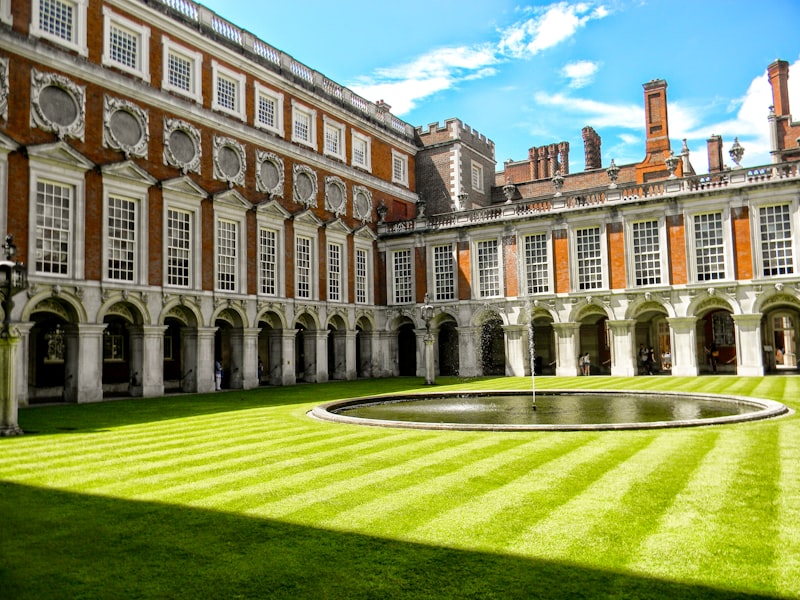
The gardens you walk through today are a palimpsest of five centuries. Tudor knot gardens sit alongside William III’s formal Privy Garden, painstakingly restored to its 1702 design. The Great Vine, planted in 1768, is the largest grapevine in the world — and still produces grapes sold at the palace each summer. The Maze, planted in the 1700s, is the oldest hedge maze in the UK.
The Highlights
The Maze — The famous draw. Planted in the 1700s, it’s genuinely tricky — allow 20—45 minutes. The oldest surviving hedge maze in Britain.
The Privy Garden — Restored to its exact 1702 design from William III’s reign. Twelve ornamental panels of clipped box, santolina, and gravel, with the Thames as backdrop. One of the finest examples of late 17th-century formal garden design in Europe.
The Great Vine — Planted by Capability Brown in 1768. The largest grapevine in the world, with a main stem over 4 metres in circumference. Still productive: grapes are harvested each August and sold at the palace.
The Wilderness — A 60-acre meadow that puts on a display of over one million daffodils each spring, followed by bluebells.
The Magic Garden — A purpose-built interactive play area for children, inspired by Tudor history — towers, water features, a dragon bridge.
2026 at Hampton Court
| Event | Dates |
|---|---|
| Tulip Festival (110,000 bulbs) | April |
| RHS Hampton Court Garden Festival | 8—12 July |
| Gardens open | 13 Apr — 18 Oct |
The RHS Hampton Court Garden Festival is one of the biggest flower shows in the world — show gardens, workshops, floral displays, and expert talks across the palace grounds.
Getting There from Kingston
| Mode | Route | Time |
|---|---|---|
| On foot | Thames Path from Kingston centre | ~45 min (3.5 miles) |
| Bus | 111, 216, 411, R68 | ~15 min |
| Train | Hampton Court station is directly outside the palace | 1 stop from Surbiton |
Comparing the Three
| Kew | Wisley | Hampton Court | |
|---|---|---|---|
| Founded | 1759 | 1903 (RHS) | 1520s (gardens) |
| Size | 300 acres | 240 acres | 60 acres |
| Focus | Global botanical science | Practical horticulture | Royal garden history |
| UNESCO status | Yes (2003) | No | No (palace is Grade I) |
| Heritage listing | UNESCO World Heritage | Grade II* (Historic England) | Grade I Listed |
| Glasshouses | Palm House (1848), Temperate House (1862) | Bicentenary Glasshouse (2007) | None |
| Scientific collections | 8.5M herbarium specimens, 2.5B seeds | RHS Herbarium, Trials Field, AGM system | None |
| Key architect | Decimus Burton, William Chambers | WilkinsonEyre, Geoffrey Jellicoe | Christopher Wren, Capability Brown |
| Adult entry | £20—22 | From £14.80 | Check hrp.org.uk |
| From Kingston | 7 miles north | 10 miles south | 3.5 miles west |
| Best for | Scale, science, Victorian architecture | Horticulture, learning, modern design | History, families, the Maze |
The Botanical Corridor: Why Kingston?
This concentration of world-class gardens isn’t an accident. The Thames Valley corridor from Richmond to Guildford has been a centre of horticulture and botanical science for nearly 300 years — driven by royal patronage (George III at Kew, Henry VIII at Hampton Court), fertile river-valley soil, mild microclimates, and the network of wealthy estates that attracted collectors, designers, and scientists.
Kingston sits at the geographical centre of this corridor. Kew to the north, Hampton Court to the west, Wisley to the south — three institutions that between them hold UNESCO World Heritage status, the world’s largest seed bank, the UK’s flagship horticultural science centre, the oldest hedge maze in Britain, the largest surviving Victorian glasshouse, and a 258-year-old grapevine that still produces fruit.
If you live here, these aren’t day trips. They’re neighbours.
Planning a Visit
One Garden, Done Properly
Each of these gardens rewards a full day. Kew and Wisley both need 3—5 hours minimum; Hampton Court is more manageable at 2—3 hours but expands if you explore the palace too.
The Best Pairing
Kew + Hampton Court works as a single day. Both are north/west of Kingston. Take the train to Kew Gardens in the morning (District Line from Richmond), spend 3—4 hours, then bus or taxi to Hampton Court for the afternoon — they’re only 20 minutes apart.
Wisley is best as a standalone — it’s south on the A3, in the opposite direction, and deserves its own day.
Seasonal Timing
| Season | Best For |
|---|---|
| Spring (Mar—May) | Battleston Hill at Wisley (rhododendrons/magnolias). Hampton Court daffodils and Tulip Festival. Kew blossom season |
| Summer (Jun—Aug) | Bowes-Lyon Rose Garden at Wisley. RHS Hampton Court Garden Festival (July). Kew at full canopy |
| Autumn (Sep—Oct) | Wisley Flower Show (September). Kew autumn colour. Hampton Court Great Vine harvest |
| Winter (Nov—Jan) | RHS Glow at Wisley. Christmas at Kew. Off-peak pricing at Kew (from £12) |
Membership That Pays for Itself
- RHS membership covers free entry to Wisley and all five RHS gardens, plus 200+ partner gardens. Worth it if you visit Wisley more than twice a year.
- Kew membership covers unlimited entry to Kew Gardens and Wakehurst. Off-peak season (Nov—Jan) already discounts to £12, so membership mainly benefits peak-season visitors.
- Historic Royal Palaces membership covers Hampton Court, Tower of London, Kensington Palace, and three other palaces.
Frequently Asked Questions
Hampton Court Palace gardens are effectively walking distance — 3.5 miles along the Thames Path from Kingston centre. For a dedicated botanical institution, Kew Gardens is 7 miles north (20 minutes by car, or train via Richmond), and RHS Garden Wisley is 10 miles south via the A3.
Kew is a UNESCO World Heritage Site focused on global botanical science — it holds the world's largest collection of living plants, a herbarium of 8.5 million specimens, and the Millennium Seed Bank. Wisley is the Royal Horticultural Society's flagship garden, focused on practical horticulture — plant trials, the Award of Garden Merit system, and gardening education. Both are extraordinary, but Kew leans scientific and Wisley leans horticultural.
Kew has the deepest history — founded in 1759 by Princess Augusta, with buildings by William Chambers and landscape by Capability Brown. Hampton Court has royal gardens dating to the 1500s. Wisley is newer (1903 as an RHS garden) but has a Grade II Listed laboratory from 1916 and a rich heritage of horticultural science.
It's possible but not recommended — each garden deserves 3-5 hours minimum. Better to do Kew and Hampton Court in one trip (they're both north of Kingston, 20 minutes apart) and save Wisley for a separate day.
Yes, all three. Kew Gardens has its own Underground and Overground station (District Line). Hampton Court has its own railway station directly outside the palace. Wisley is served by the 714 bus from Kingston bus station (hourly, 50 minutes) with a 30% discount on entry for car-free visitors.
Kew, without question. The Palm House (1844-1848) was the first large-scale structural use of wrought iron in architecture, and the Temperate House is the largest surviving Victorian glass structure in the world. Both are architectural landmarks as much as botanical ones.
Found this useful?
Kingston Compass is independent and ad-free. If this guide helped you discover somewhere new, a coffee helps keep us going.
About this guide
This guide is part of Kingston Compass, covering Kingston, Surbiton and New Malden. We focus on practical local recommendations and regularly checked information. All venues are researched and verified by our local team.
Featured in this guide
1 curated place
Local Activities
Royal Botanic Gardens, Kew
A UNESCO World Heritage Site and one of the most important botanical institutions on Earth. 300 acres of gardens, glasshouses, and living collections — just 7 miles north of Kingston.
RHS Garden Wisley
One of the world's great gardens — 240 acres of horticultural inspiration in Surrey, from the soaring Glasshouse to the Rose Garden and Battleston Hill. Just 20 minutes from Kingston by car, or take the 715 bus direct.