A palace built on ambition
Hampton Court Palace stands eight miles upstream from Kingston town centre — close enough to walk the Thames Path in an afternoon, far enough to feel like a proper day out. It is one of only two surviving palaces from the Tudor era, and it has more history packed into its courtyards and corridors than most cities manage in a lifetime.
This is not a summary of the audio guide. This is the story of the building, the people who shaped it, and what makes it worth visiting from Kingston today.
The Wolsey years: 1514–1529
In 1514, Thomas Wolsey — Lord Chancellor to Henry VIII, Archbishop of York, and the most powerful man in England after the King — leased a manor house on the north bank of the Thames. He had the building demolished and started again from scratch.
What Wolsey built was not a modest country retreat. It was a palace designed to host foreign ambassadors, entertain royalty, and project the kind of wealth that made his contemporaries uncomfortable. He installed running water, built a vast kitchen complex, and filled the rooms with tapestries and plate.
The message was clear: Wolsey was not just serving the King — he was rivalling him.
Henry takes the palace: 1529–1547
By 1529, Wolsey had failed to secure Henry’s annulment from Catherine of Aragon. Sensing the tide turning against him, he gave the palace to the King — a gift born of desperation rather than generosity.
Henry spent approximately 47,000 pounds — an extraordinary sum — transforming Hampton Court into the most lavish country residence in England. He built the Great Hall with its spectacular hammerbeam roof, expanded the kitchens to 36,000 square feet (where 200 staff prepared 800 meals twice daily), and laid out the gardens, tennis courts, and tiltyards that made the palace a self-contained world.
The palace became the backdrop to some of the most dramatic events in English history:
- Jane Seymour gave birth to the future Edward VI here in October 1537, then died twelve days later in the same rooms
- Catherine Howard was arrested here in November 1541 — legend holds she broke free from her guards and ran screaming through what is now called the Haunted Gallery, trying to reach Henry in the Chapel Royal
- The break with Rome and the English Reformation reshaped every aspect of court life within these walls
The baroque rebuilding: 1689–1694
Hampton Court’s second great transformation came under William III and Mary II. William wanted a palace to rival Versailles, and he hired Sir Christopher Wren to rebuild the state apartments.
Wren demolished much of the Tudor east wing and replaced it with the baroque Fountain Court — grand, symmetrical, and unmistakably continental. The King’s Apartments and the Queen’s Apartments date from this period, with their painted ceilings, carved doorways, and formal gardens stretching down to the Thames.
Mary II died of smallpox in 1694 before the work was complete. William continued the project, but never with the same enthusiasm.
The palace the Tudors and Stuarts left behind
What makes Hampton Court unusual — and what you notice immediately when you walk through Base Court — is that both eras survive side by side. The Tudor gatehouse and Great Hall sit yards from Wren’s baroque facades. The result is a palace that reads like a textbook in brick and stone.
The Haunted Gallery
The most atmospheric space in the palace. This long, dim corridor connects the royal apartments to the Chapel Royal. Catherine Howard’s ghost is said to haunt it — visitors and staff have reported screams, cold spots, and unexplained presences over centuries. Whether you believe in ghosts or not, the gallery has a weight to it that is hard to explain.
The Maze
The oldest surviving hedge maze in Britain, over 300 years old. It covers a third of an acre and takes most visitors about 20 minutes to solve. It was originally planted for William III as a fashionable garden feature, and it remains one of the most popular attractions at the palace.
The Great Vine
Planted in 1768 by Lancelot ‘Capability’ Brown, this Black Hamburg grapevine is certified by Guinness World Records as the largest in the world. It still produces grapes each summer, which are sold in the palace shop. The vine has its own heated glasshouse and a root system that extends under the palace grounds.
The Tudor Kitchens
A 36,000-square-foot complex that is the best-preserved Tudor kitchen in Europe. In Henry’s day, 200 staff worked here to feed the court — producing around 800 meals twice daily. The scale is extraordinary: the Great Kitchen alone has six fireplaces, and the cellars stored 600,000 gallons of ale a year.
After the Tudors
Hampton Court stopped being a primary royal residence after George II. In 1838, Queen Victoria opened the palace and gardens to the public — free of charge. It became a popular day trip for Londoners, and it has remained one ever since.
One notable later resident: Michael Faraday, the pioneering physicist and chemist, lived in a grace-and-favour apartment at the palace from 1862 until his death in 1867.
Getting there from Kingston
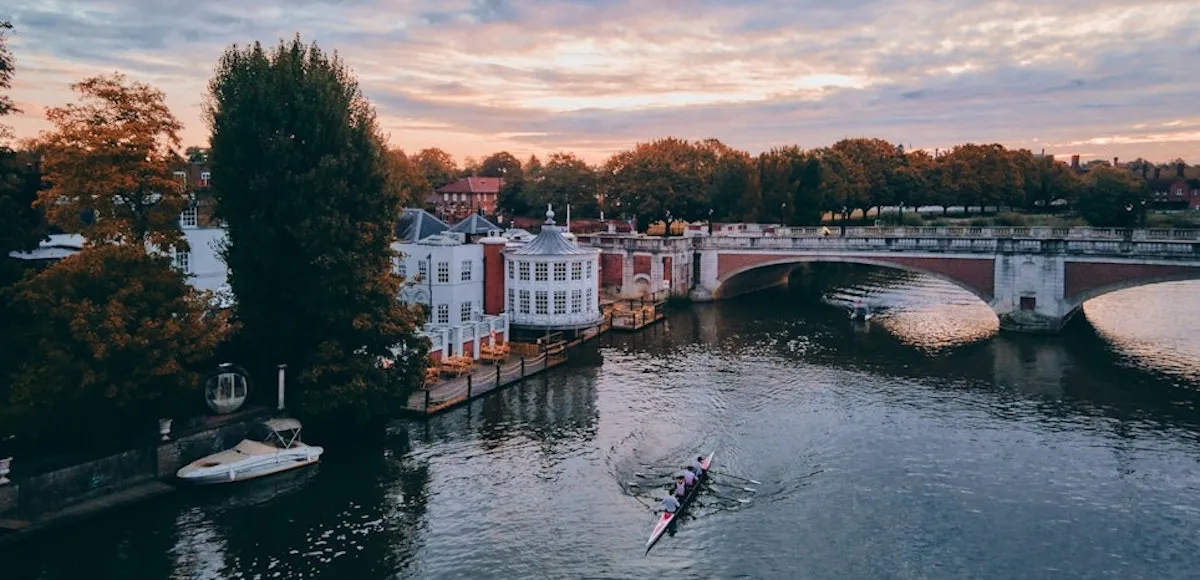
The best way to arrive is on foot. The Thames Path from Kingston town centre to the palace is about 3 to 3.5 miles — flat, fully accessible, and scenic the entire way. You pass through riverside meadows and along the towpath before the palace appears on your left.
If walking is not your thing, buses and trains run from Kingston. But the walk is part of the experience — this is the same route that courtiers, ambassadors, and Tudor nobles would have taken by barge.
Visiting today
Hampton Court is managed by Historic Royal Palaces. Entry includes the State Apartments, the Tudor Kitchens, the Haunted Gallery, the Great Vine, and the gardens. The Maze requires a separate ticket or is included with certain admission types.
The Magic Garden — a children’s play area inspired by Tudor myths and legends — makes the palace a genuine family destination, not just a history lesson with a gift shop.
Check the Historic Royal Palaces website for current prices and opening times.
Frequently Asked Questions
Walk the Thames Path from Kingston town centre — it's about 3 to 3.5 miles, flat and scenic the whole way. Or take the bus or train from Kingston station. The walk is the best option if the weather is good.
Building began in 1514 when Cardinal Thomas Wolsey leased the site. Henry VIII took it over in 1529. The palace has been standing for over 500 years.
Yes. It is the oldest surviving hedge maze in Britain, over 300 years old. It takes most people 20 minutes to find the centre. Children love it.
Legend has it that Catherine Howard's ghost runs screaming through the Haunted Gallery, retracing her desperate dash to plead with Henry VIII after her arrest in 1541. Staff and visitors have reported unexplained sounds there over the centuries.
Planted in 1768, it is certified by Guinness World Records as the largest grapevine in the world. It still produces Black Hamburg grapes each year.
Very. The Magic Garden is a children's play area inspired by Tudor history. The maze is a hit with all ages. The kitchens and state apartments appeal to older children interested in history.
Found this useful?
Kingston Compass is independent and ad-free. If this guide helped you discover somewhere new, a coffee helps keep us going.
About this guide
This guide is part of Kingston Compass, covering Kingston, Surbiton and New Malden. We focus on practical local recommendations and regularly checked information. All venues are researched and verified by our local team.