Three catalysts that built Korea Town
New Malden’s Korean community — estimated at 10,000 in the immediate area and 20,000 in the wider surroundings — didn’t happen by accident. Three specific things pulled Korean families to this quiet London suburb, each building on the last.
The ambassador’s residence. In the 1950s, South Korea’s first UK embassy took over a house on Lord Chancellor’s Walk, Coombe Lane West, near New Malden. Korean diplomats and their networks gravitated to the area. A former ambassador later settled here permanently, and Korean expatriates followed.
The radar deal. Around the same time, a South Korean chaebol — the specific company has not been identified in available sources — signed a joint venture with Decca Radar, a British electronics firm based in New Malden. This brought the first Korean business personnel to the area.
Samsung. Around 1980, Samsung Electronics established its first European headquarters on Woodside Road, New Malden. This was transformative. Waves of Korean corporate employees arrived with their families, needing housing, schools, shops, and services. Other Korean companies followed Samsung’s lead.
Samsung relocated to Chertsey in 2005. By then, 25 years of chain migration had made the community self-sustaining. Korean churches, schools, shops, and restaurants had created a complete social infrastructure. The company that catalysed the community had moved on; the community stayed.
The food followed the people
The first Korean restaurant in New Malden opened in 1991 — a full decade after Samsung arrived. This sequence matters. New Malden’s Korean food scene is often presented as the community’s defining feature, but the restaurants came after the people, not before. The community was built on corporate transfers, church networks, property prices, and school quality. The roughly 20 Korean restaurants on the High Street today are a consequence of the community, not the cause.
The restaurants came after the community was already established. The food followed the people — not the other way around.
Why New Malden rather than central London? The reasons are practical: property prices significantly cheaper than nearby Wimbledon and Kingston, direct trains to Waterloo in 24 minutes, leafy suburban streets with gardens (a contrast to Seoul apartment living), good schools, and — an often-overlooked factor — an existing Japanese community that had created some East Asian infrastructure in the area.
Little Pyongyang
The most sensitive chapter of New Malden’s Korean story involves North Korean defectors.
The first North Korean officially claimed asylum in the UK in 2004. More followed, drawn to New Malden because the existing South Korean business infrastructure offered employment that didn’t require fluent English. Most are “secondary migrants” — they first escaped to South Korea, acquired South Korean passports, then migrated onward to Britain. They chose the UK partly for its distance from North Korea, and partly because it was neither the United States nor South Korea, countries they had been taught to regard as enemies.
At its peak, an estimated 600 to 1,000 North Koreans lived in New Malden — the largest such community outside the Korean Peninsula. Some residents call it “Little Pyongyang.”
The relationship between the North and South Korean communities is generally amicable but complex. Most North Korean defectors work at South Korean-run businesses. Korean churches serve as meeting points where both communities socialise. But Kingston Council’s Joint Strategic Needs Assessment found important differences: the two communities “interface but have differing cultures,” shaped by “very different immigration histories and different social and economic circumstances.”
— Kingston Council JSNA, 2018The Korean community is not unified or homogeneous. The North Korean community is much more vulnerable than the South Korean community. Poverty is a particular concern.
The North Korean community faces challenges. Tightened British immigration policy has slowed new arrivals. North Korea’s “shoot to kill” orders at borders have reduced the number of people escaping. Some residents have left for South Korea. The community that once numbered around 1,000 is believed to be shrinking.
Organisations like Connect: North Korea (established 2018) provide community support — English-language learning, music therapy, psychotherapy, advocacy, and a mentoring programme for young North Koreans. The Korean Information Centre, a partnership between Theatre for All, Kingston Environment Centre, and the Metropolitan Police, offers resettlement programmes.
Royal recognition
On 8 November 2023, King Charles III visited New Malden’s Korean community ahead of the South Korean President’s State Visit. He visited the Methodist Church, met community representatives, and toured local Korean businesses. It was the highest-level acknowledgment of New Malden’s Korean identity.
In January 2023, the Royal Borough of Kingston became the first place in Europe to declare 22 November as International Kimchi Day. The Korea Town Foundation CIC was incorporated in November 2022 to formalise community development and expand UK-Korea cooperation.
These are markers of how far the community has come from a radar deal and an ambassador’s house in the 1950s. Seventy years of chain migration, starting with diplomats and corporate transfers, built something that a king came to recognise.
The numbers and the caveats
The UK census doesn’t separately identify Koreans — they’re classified under “Other Asian.” This makes precise population tracking difficult. The commonly cited figure of 10,000 Koreans in New Malden and 20,000 in the wider area comes from community organisations and media reports, based on estimates from 2014-2015. North Korean population figures (600-1,000 at peak) come from UN data, the European Alliance for Human Rights in North Korea, and media investigations. All should be understood as approximations.
Whether New Malden has formal “Korea Town” designation is also somewhat ambiguous. The community is widely referred to as “Korea Town” or “Little Korea” in media and everyday use, but this appears to be informal recognition rather than a formal municipal designation comparable to Koreatowns in some American cities. The Korea Town Foundation CIC and Kingston Council’s active engagement suggest this may change.
What this place represents
The 2018 documentary Little Pyongyang, directed by Roxy Rezvany, won multiple awards for its portrayal of North Korean defectors in New Malden. The UK deployed over 81,000 personnel in the Korean War, with more than 1,100 fatalities. The relationship between Britain and Korea runs deeper than a suburban high street.
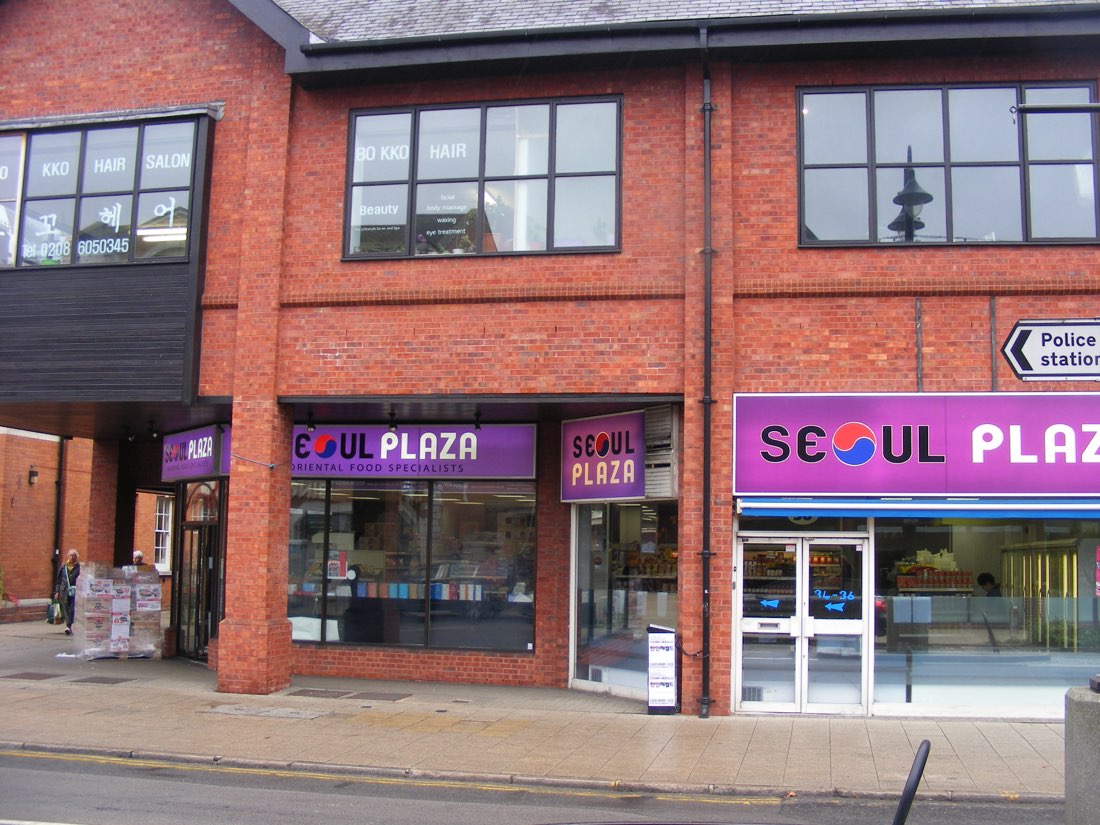
But the high street is where you see it today — in the Korean signage, the supermarkets, the kimchi festivals, and the community that Samsung’s departure in 2005 didn’t dislodge. New Malden became Korea Town not through grand civic planning but through the accumulated choices of thousands of families who found, in a quiet London suburb, something that felt like home.
Key Dates
UK becomes first European country to recognise South Korea
Formal diplomatic recognition on 18 January 1949 laid the foundations for the relationship that would eventually transform New Malden.
First Korean connections to New Malden
A South Korean chaebol signed a joint venture with Decca Radar, a British electronics firm based in the area. The Korean ambassador's residence was established on Coombe Lane West.
Samsung opens its first European headquarters
Located on Woodside Road, New Malden. Samsung's presence brought waves of Korean corporate employees and their families, triggering chain migration.
First Korean restaurant opens in New Malden
A decade after Samsung arrived — the food followed the people, not the other way around.
First North Korean claims asylum in the UK
North Korean defectors begin gravitating to New Malden for the existing Korean business infrastructure and community support.
Samsung relocates to Chertsey
The company that catalysed the community moves away — but by now, 25 years of chain migration has made the community self-sustaining.
H Mart opens first European store
The major Korean supermarket chain chose New Malden for its inaugural European location — a marker of the community's scale and commercial significance.
Korea Town Foundation CIC incorporated
Formalising efforts to develop the Korean community and expand UK-Korea cooperation.
Kingston declares International Kimchi Day
In January, the Royal Borough of Kingston became the first place in Europe to declare 22 November as International Kimchi Day.
King Charles III visits New Malden
On 8 November, ahead of the South Korean President's State Visit, the King visited the Methodist Church, met community representatives, and toured local Korean businesses.
About this heritage page
Part of Kingston Compass's heritage series, covering the historical significance of Kingston, Surbiton and New Malden. Every claim on this page is source-backed. Where evidence is uncertain, we say so.